
Handwriting vs. Typing: Which Notes Do You Actually Remember?
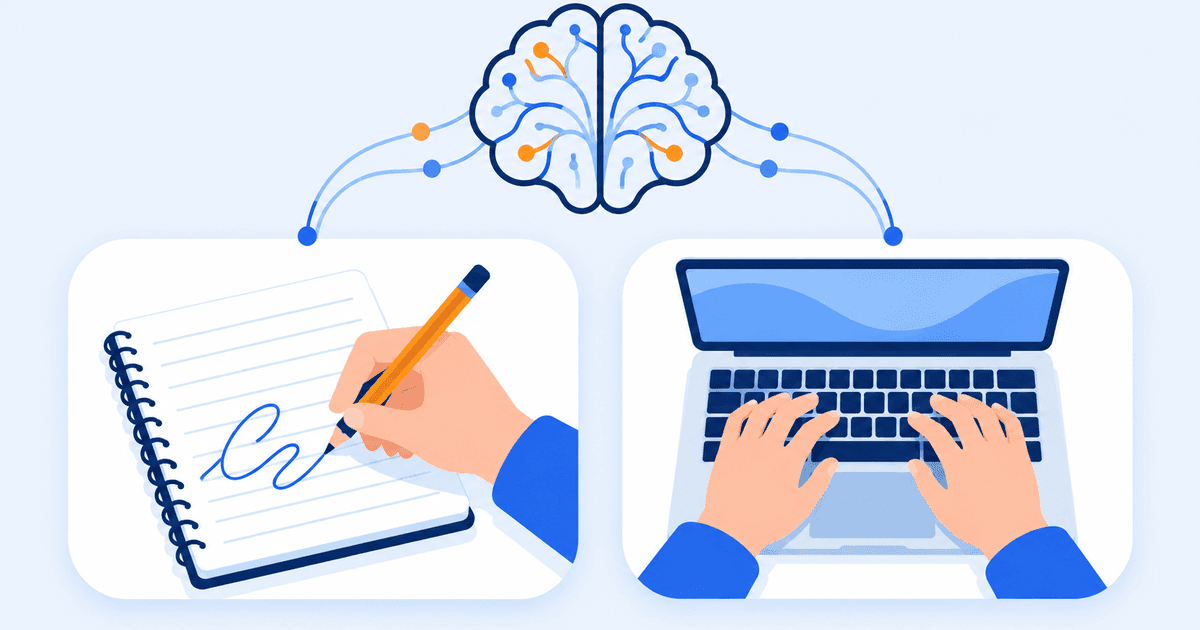
In brief: "Handwriting sticks better" is true only under conditions. Mueller and Oppenheimer (2014, Psychological Science) reported that students who took lecture notes on a laptop copied more verbatim and did worse on conceptual questions than those writing by hand. But a direct replication by Urry and colleagues (2021, same journal) reproduced the verbatim difference and not the test-score difference. What matters is not the instrument but whether you restate content in your own words. For children learning letters, on the other hand, handwriting practice consistently improves letter recognition, and a 2024 EEG study found widespread brain synchronization during handwriting. As a rule of thumb: to remember content, paraphrase as you write; to learn the shape of letters or figures, write by hand.
Should you take lecture or meeting notes by hand or on a keyboard? And now that AI can summarize a recording, do you need to take notes at all? The claim that handwriting sticks better is common, but the study behind it has wobbled under replication. This article separates the famous study from its replications, the brain research, and the research on children learning to write, to see what can actually be said.
The "pen is mightier than the keyboard" study
The starting point is Mueller and Oppenheimer (2014, Psychological Science). University students watched lectures such as TED talks, half taking notes on a laptop and half by hand, then answered factual and conceptual questions.
There was no difference on factual questions, but the handwriting group did better on conceptual ones. Analysis of the notes showed the laptop group copied the lecturer's words verbatim at a higher rate, while the handwriting group summarized and paraphrased more. The authors' interpretation: typing is fast enough to transcribe without thinking, while handwriting is slow enough to force selection and rewording. The idea that paraphrasing aids memory matches the depth-of-processing account discussed in the metacognition article.
The study spread widely under its title and became a reason to keep laptops out of classrooms.
The difference that vanished on replication
Repeating the procedure produced unstable results. Urry and colleagues (2021, Psychological Science) ran a direct replication with 145 participants across several universities. The verbatim difference (more copying on laptops) replicated. The test-score difference did not: handwriting and laptop groups scored about the same.
A 2019 replication by Morehead and colleagues likewise found the conceptual-question difference was not statistically significant, suggesting the original effect was overestimated. The current evidence supports the following.
- Typing encourages verbatim copying (replicated)
- The instrument alone does not change test performance (not replicated)
The factor that remains is copying versus paraphrasing. If you type while deliberately not transcribing what you hear, you can expect learning comparable to handwriting. Conversely, copying the board word for word by hand will do little.
What the EEG study showed
There are also reports that the brain is more active during handwriting. van der Weel and van der Meer (2024, Frontiers in Psychology) had 36 university students write words by hand (with a pen on a tablet) or by typing while recording EEG. During handwriting, low-frequency synchronization increased across broad parietal and central regions; it did not during typing.
This shows handwriting is a complex act that processes visual, motor, and tactile information at once. But there is a caveat: the study measured brain activity only and did not test whether the words were remembered later. "More of the brain is active" and "it sticks better" are different questions, and the first does not imply the second.
For children learning letters, handwriting wins
The most consistent evidence concerns not adult note-taking but children learning letters. James and Engelhardt (2012, Trends in Neuroscience and Education) had pre-literate children around age 5 practice letters by freehand writing, tracing, or typing, then measured brain activity while they looked at letters. Only freehand writing activated the reading network seen in adults.
Longcamp and colleagues (2005, Acta Psychologica) also had children aged 3 to 5 practice letters by handwriting or typing and found better letter recognition in the handwriting group. Learning a letter's shape as a writing movement seems to ground the ability to recognize it visually.
This bears on figure recognition in general. Spatial reasoning tasks that rotate and combine shapes are likely easier to manipulate mentally the more experience you have drawing by hand.
AI summaries skip the paraphrasing step
Taken together, what determines whether content sticks is not the instrument but the step of restating it in your own words. Seen this way, having AI summarize a recording calls for care: reading the summary removes the paraphrasing step entirely.
As covered in the cognitive offloading article, processing handed to an external tool is less likely to be remembered. If learning is the goal, summarize first yourself, then compare against the AI's version to catch gaps. If the goal is a record and there is nothing to memorize, letting AI handle it is fine.
A rule of thumb
- To remember a lecture or a book: the instrument does not matter. Do not transcribe; restate briefly in your own words
- To learn the shape of letters, figures, or formulas physically: write by hand. This matters most for children learning letters
- For a record you do not need to memorize: typing or an AI summary is enough
- For review: rather than rereading, recall without looking and then check (see the memory article)
To check your own tendencies in memory and figure processing, BrainRank's free IQ test scores 20 questions (about 10 minutes) across spatial reasoning, pattern recognition, logical reasoning, and classification using item response theory (IRT) and returns per-domain tendencies. Results are estimates for entertainment and self-understanding, not a medical or diagnostic assessment.
Frequently asked questions
- Which helps you remember notes better, handwriting or typing?
- Replications have found almost no difference from the instrument itself. What matters is whether you restate the content in your own words or copy it as heard. Typing is fast enough to encourage verbatim copying, so if you summarize deliberately while typing, you can expect memory comparable to handwriting.
- Do children need handwriting to learn letters?
- It appears so. Preschool children who practice letters by freehand writing recognize them better than those who practice by typing or tracing, and their reading-related brain regions become more active. Learning a letter's shape as a movement seems to lay the foundation for recognizing it.
- Does letting AI summarize hurt learning?
- Skipping the step of building the summary yourself makes content less likely to stick. Note-taking research shows that memory forms not at the moment of writing but at the moment of paraphrasing. Reading an AI summary removes that step. If you use AI, summarize first and then compare against its version.
Share this article
Related articles
- Low Working Memory: Signs in Adults and Children, and What Helps
- Digital Dementia and the Smartphone Brain: What the Research Found
- How to Train Your Working Memory: 5 Everyday Methods
- Does Relying on AI Weaken Thinking? The Science of Cognitive Offloading
- What Is Cognitive Bias? Common Types and How to Reduce Them
- Can You Raise Your IQ? An Honest Look at Training and Its Limits
Editorial note & disclaimer
BrainRank Editorial Team
This article was written and edited by the BrainRank Editorial Team with reference to academic literature on psychometrics, including CHC theory and Item Response Theory (IRT). Statistics and percentages are calculated from a normal distribution model with a mean of 100 and a standard deviation of 15.
The tests on this site provide estimates for entertainment and self-understanding purposes only. They are not medical or clinical assessments, nor official psychological (intelligence) tests.