
What Is Cognitive Bias? Common Types and How to Reduce Them
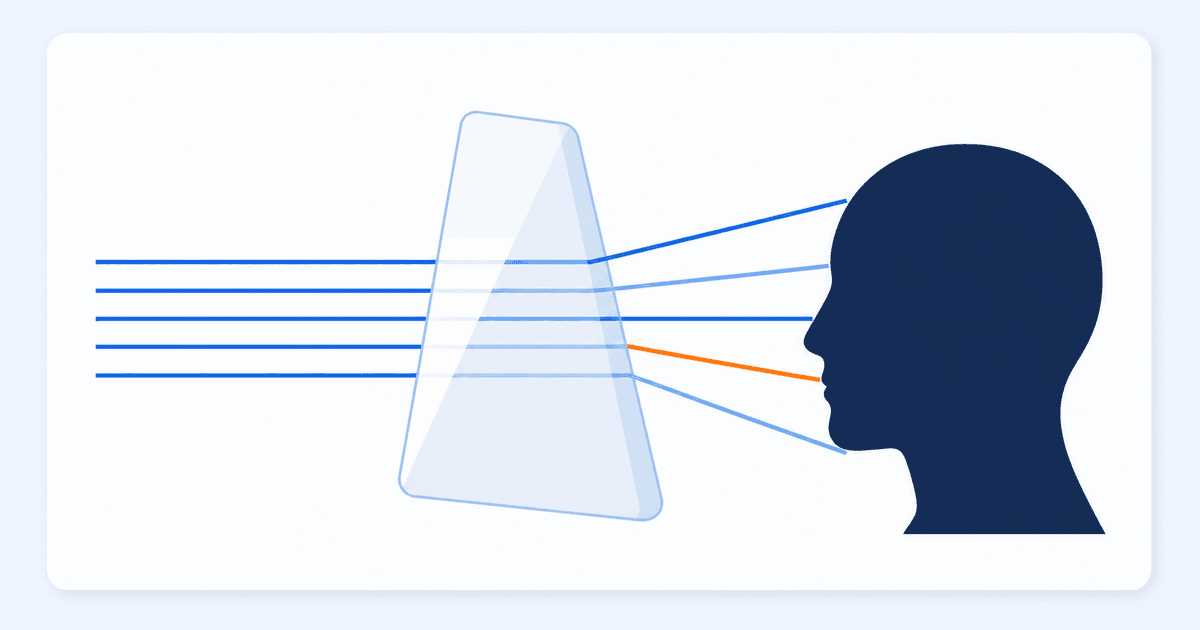
In brief: Cognitive bias is the systematic tilting of judgment and memory in a particular direction. Since Tversky and Kahneman's 1974 work it has been explained as a side effect of the shortcuts (heuristics) that let us judge quickly from limited information. Knowing the list does not prevent it; the procedure of judging has to change.
Cognitive bias is the tendency for judgment and memory to tilt systematically in a particular direction. The important part is that it is not random error. Because many people tilt the same way, the tilt can be anticipated and countered in advance. This article covers the common types, why knowing them is not enough, and the procedures that actually reduce them.
What cognitive bias is: a side effect of heuristics
The modern research starts with Tversky and Kahneman (1974, Science). That paper showed that when people judge probability or frequency, they rely on a small number of shortcuts (heuristics) under limits of information and time, and that those shortcuts produce systematic errors.
Bias is therefore a design trade-off rather than a flaw in thinking. Handling every judgment rigorously would raise accuracy, but the time and attention are not there. As what cognitive abilities are sets out, there is a ceiling on how much can be handled at once, which makes shortcuts a reasonable adaptation.
Ten common cognitive biases
Taxonomies differ across sources; these are the ones most often encountered in practice.
- Confirmation bias: gathering information that supports your view and discounting evidence against it
- Anchoring: the first number you see dragging every subsequent estimate toward it
- Availability heuristic: treating easily recalled events as more likely than they are
- Hindsight bias: feeling, after learning the outcome, that you knew it all along
- Survivorship bias: looking only at what remains and never counting what disappeared
- The Dunning-Kruger effect: self-assessment drifting furthest from ability in the weakest domains
- Authority bias: judging by the speaker's title rather than the content of the claim
- Sunk cost effect: delaying withdrawal because of time and money already spent
- Fundamental attribution error: attributing others' failures to character and your own to circumstance
- Bias blind spot: seeing bias in others while believing you are free of it
The last one is the awkward one. The more you learn about bias, the easier it becomes to point it out in others while growing more confident that your own judgment is sound.
Why knowing about them does not prevent them
The gap between self-assessment and ability is known as the Dunning-Kruger effect. Judging your performance in a domain accurately requires competence in that same domain, which makes the structure recursive.
For the same reason, memorizing the categories does not fire when a judgment is actually being made. Bias operates where judgment is fast and automatic, and for knowledge to interrupt it, something has to stop you. Rather than expecting that signal from inside, put it outside as a procedure.
Four procedures that reduce bias
Each of these inserts a fixed step before or after the judgment.
1. Set criteria first: before seeing the candidates, write what would qualify as acceptable. This works on both anchoring and confirmation bias.
2. Assign yourself the counterargument: write at least three reasons your conclusion could be wrong.
3. Review on information available at the time: evaluate on what you knew when you decided, not on the outcome. This separates out hindsight bias.
4. Write the exit condition first: decide at the start what would make you stop. That closes off the sunk cost effect.
These four apply the checking step of metacognition to the moment of judgment. What they share is testing against criteria fixed in advance rather than against how it feels at the time. The full procedure is laid out in how to build critical thinking, and the same steps work for evaluating generative AI output (see AI and cognitive offloading).
Make a habit of checking numbers yourself
The fastest way to reduce bias is to verify figures that were offered as impressions. What percentile an IQ of 130 sits at, for example, follows deterministically from a normal distribution with a mean of 100 and a standard deviation of 15 (see our IQ distribution data). BrainRank's free IQ test returns an estimated IQ and domain tendencies from 20 questions in about 10 minutes, and that too should be read as a range including measurement error rather than a fixed value. Results are estimates for self-understanding, not an official psychological assessment.
Frequently asked questions
- What is cognitive bias in simple terms?
- It is the tendency for judgment and memory to tilt systematically in a particular direction. It is not random error: because many people tilt the same way, the tilt can be anticipated and countered.
- Are intelligent people immune to cognitive bias?
- Not necessarily. Bias is not a defect in intelligence but a side effect of judging quickly with limited resources. Believing that you personally are unbiased is itself one of the biases, known as the bias blind spot.
- Can cognitive bias be reduced?
- Memorizing the categories barely helps. Building procedures into the process works better: look for the counterargument first, set criteria before you judge, and review decisions on the information available at the time rather than on the outcome.
Share this article
Related articles
- ADHD and IQ: Is Average IQ Lower? WISC Profiles and High-IQ ADHD
- Autism and IQ: Intellectual Disability Rates and Test Profiles
- Does Reading Raise IQ? What Twin Studies and Meta-Analyses Show
- Tanaka-Binet Intelligence Scale: IQ Scoring, V vs. VI, and WISC
- 10 Brain-Boosting Hobbies — With an Honest Look at the Limits
- How to Train Your Working Memory: 5 Everyday Methods
Editorial note & disclaimer
BrainRank Editorial Team
This article was written and edited by the BrainRank Editorial Team with reference to academic literature on psychometrics, including CHC theory and Item Response Theory (IRT). Statistics and percentages are calculated from a normal distribution model with a mean of 100 and a standard deviation of 15.
The tests on this site provide estimates for entertainment and self-understanding purposes only. They are not medical or clinical assessments, nor official psychological (intelligence) tests.