
Does Relying on AI Weaken Thinking? The Science of Cognitive Offloading
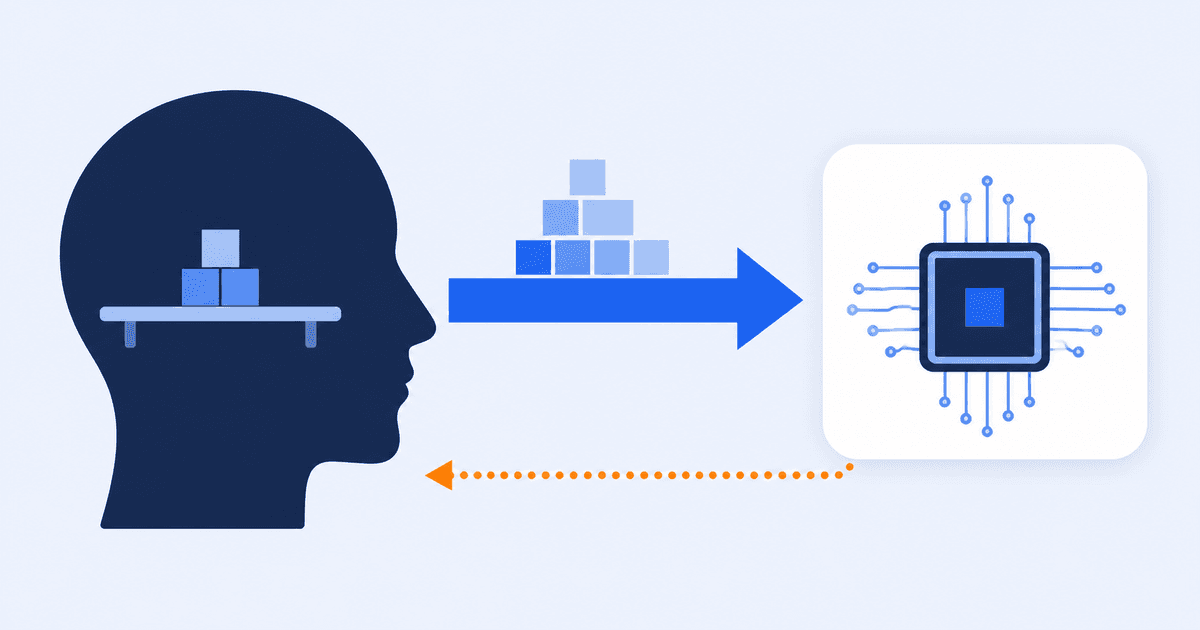
In brief: Cognitive offloading means handing memory or computation to an external tool to reduce cognitive demand. Studies have reported a correlation between AI use and lower measures of critical thinking, but none has established causation. When learning is the goal, producing your own answer before checking it against AI is the useful order.
The worry that leaning on AI will erode your ability to think has a name in the research literature: cognitive offloading. It means handing memory or computation to an external tool to lighten the load on your head. The short answer is that offloading is a normal and useful strategy; it becomes a problem only when building the process itself was the point of the task.
What cognitive offloading is
The review by Risko and Gilbert (2016) defines cognitive offloading as 'the use of physical action to alter the information processing requirements of a task so as to reduce cognitive demand.' Tilting your head to view a rotated image and setting a phone reminder for an appointment both count.
AI use is therefore not a new species of behavior but an extension of notes, calculators, and search engines. What makes that review important is its observation that the decision to offload depends on your estimate of your own memory, and that this estimate is often wrong. What gets handed off is governed by self-assessed ability rather than actual ability.
What is lost and what remains
Offloading reliably lowers the effort a task requires right now. What tends to shrink is the amount that remains usable on your own afterward. The classic demonstration is Sparrow et al. (2011), which reported that when people expect to be able to look information up later, recall for the content itself drops while memory for where to find it strengthens.
Work from that period has been subject to replication debate, so it is safer not to overstate the effect size. The direction is the robust part, and the trade of remembering the location while releasing the contents matches everyday experience. As what cognitive abilities are sets out, memory is only one part of cognition, but it is also the base that supplies material for reasoning.
AI and critical thinking: the reported correlation and its limits
On generative AI specifically, Gerlich (2025) surveyed 666 people and reported a negative correlation between frequency of AI tool use and measures of critical thinking, arguing that cognitive offloading mediates the relationship. It has been widely cited, and its nature is worth stating precisely:
- It is cross-sectional, so no temporal ordering is established
- Critical thinking is measured partly by self-report
- Factors that could drive both, such as age and years of education, cannot be fully removed
The accurate reading is therefore not 'AI use lowers critical thinking' but 'heavier users tend to score lower.' The causal arrow is equally consistent with people who prefer to avoid cognitive effort using AI more. Reading causation into a correlation is itself a textbook cognitive bias. The procedure for separating claim, evidence, and assumption is covered in how to build critical thinking.
How to read the MIT EEG study
Kosmyna et al. (2025) compared an AI group, a search-engine group, and a no-tools group on an essay-writing task with 54 participants, reporting the weakest inter-regional brain connectivity in the AI group along with lower quotation accuracy and lower sense of ownership over their own text. The phrase 'cognitive debt' is what made it travel.
The study is suggestive, but it is a preprint that has not been peer reviewed, with 54 participants and a single task type. It does not carry the weight of 'AI breaks your brain.' What it does support is narrower: for the same finished product, what remains afterward differs depending on whether you assembled it or received it.
Using AI without losing the learning
There is one criterion: does this process need to stay inside you?
- It needs to stay: produce your own answer first, then compare and look only at the difference
- It needs to stay: verify the basis of the output yourself and find at least one error
- It does not: routine conversion, formatting, and first-pass translation can be delegated from the start
- Either way: ask for the steps, not just the conclusion, and follow them yourself
This is the mirror image of the transfer argument: a trained task improves, but the improvement does not necessarily spread to intelligence in general. Whatever you hand to AI is not being trained on your side. Conversely, if you can decide deliberately what to delegate, the attention you free up can go to judgment and verification.
Check the base you reason from
Deciding how to use AI is easier when you know your own tendencies without tools in hand. BrainRank's free IQ test is nonverbal, solved without references or a calculator: 20 questions in about 10 minutes across spatial reasoning, pattern recognition, logical reasoning, and classification, reported domain by domain. Results are estimates for self-understanding, not a medical or diagnostic assessment.
Frequently asked questions
- Does using AI make you less intelligent?
- There is no evidence that supports that claim outright. Studies report correlations, but they are mostly cross-sectional and rely on self-report, so the direction of causation is unidentified. The same data are equally consistent with people who prefer to avoid cognitive effort using AI more.
- Is cognitive offloading a bad thing?
- No. Like notes or a calculator, it is a normal strategy for redirecting limited attention toward the judgments that matter. It becomes a problem only when the point of the task was to build the process itself.
- How can I use AI and still keep my thinking sharp?
- Produce your own answer first and then compare it with the AI's, verify the basis of its output yourself, and do not offload material you need to remember. Asking for the steps rather than only the conclusion also helps.
Share this article
Related articles
- ADHD and IQ: Is Average IQ Lower? WISC Profiles and High-IQ ADHD
- Autism and IQ: Intellectual Disability Rates and Test Profiles
- Does Reading Raise IQ? What Twin Studies and Meta-Analyses Show
- Is IQ Genetic? What Heritability Really Means, and the Role of Environment
- Can You Raise Your IQ? An Honest Look at Training and Its Limits
- Handwriting vs. Typing: Which Notes Do You Actually Remember?
Editorial note & disclaimer
BrainRank Editorial Team
This article was written and edited by the BrainRank Editorial Team with reference to academic literature on psychometrics, including CHC theory and Item Response Theory (IRT). Statistics and percentages are calculated from a normal distribution model with a mean of 100 and a standard deviation of 15.
The tests on this site provide estimates for entertainment and self-understanding purposes only. They are not medical or clinical assessments, nor official psychological (intelligence) tests.