
What Is Metacognition? Meaning, Examples, and Three Ways to Train It
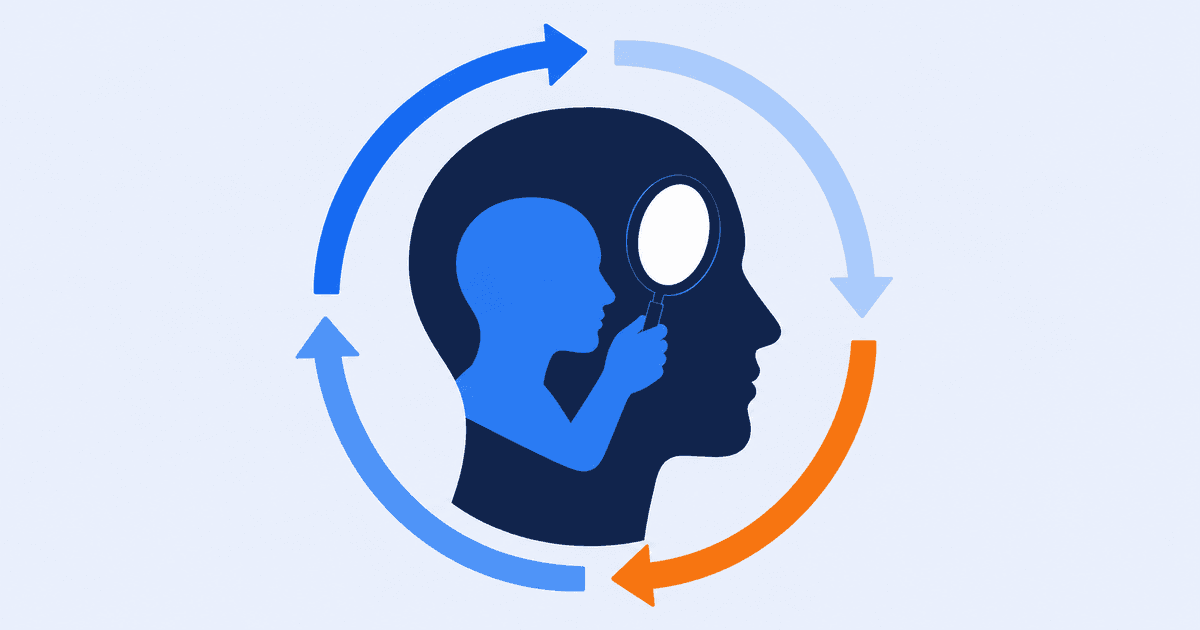
In brief: Metacognition is the capacity to treat your own thinking and understanding as an object, monitor it, and adjust as needed. John H. Flavell introduced the term in 1979. Self-rated understanding diverges easily from actual performance, so building a checking step into the process pays off directly in learning efficiency.
Metacognition is the capacity to treat your own thinking and understanding as an object, monitor it, and adjust your approach when needed. Put simply, it is the ability to go and look at how much you currently understand. This article covers the definition from psychology, everyday examples, and three procedures you can use today.
What metacognition is: a framework from 1979
The term metacognition was introduced by Flavell (1979) as 'cognition about cognitive phenomena.' That paper organizes it into four components: metacognitive knowledge, metacognitive experiences, goals or tasks, and actions or strategies.
For practical use, a two-layer split is easier to work with:
- Metacognitive knowledge: what you know about your own strengths and about which method suits this task
- Metacognitive control: checking whether you currently understand, and changing method when you do not
The second is the hard one. Knowing that review matters is a separate question from whether you can accurately estimate your own understanding in the moment. For where this sits relative to cognition itself, see what cognitive abilities are.
What it looks like in practice
It sounds abstract, but it happens constantly.
- Reading a textbook, noticing that your eyes passed over a paragraph without it going in, and rereading
- Thirty seconds into a problem, judging that this approach will not finish in time and switching
- Watching a listener's expression change and realizing you skipped a premise
- Before an exam, distinguishing 'I could solve this' from 'I have actually solved this'
What they share is attention on the state of the work rather than the work itself. The rule in matrix reasoning to move on if no approach forms within 30 seconds is metacognitive control exactly.
The core of metacognition is the checking step
Metacognition can be drawn as a loop: plan, do, monitor, adjust. Monitoring is the step most often skipped, because completing the work itself produces a sense of accomplishment and carries you into the next thing without verifying the result.
When checking drops out, self-rated understanding drifts away from actual performance. The extreme form of that divergence is the Dunning-Kruger effect: judging your performance in a domain accurately requires competence in that same domain, which makes the structure recursive.
Three procedures for training it
Metacognition is a procedure, not a personality trait. Each of these moves the checking step outside your head so it actually runs.
1. Write the prediction first: before solving, write one line on how long it will take and whether you will get it right. Compare with the measurement afterward. The direction of the gap is your personal bias.
2. Confirm by explaining: say the material aloud as if teaching it, with no references. Wherever you stall is exactly what you only felt you understood.
3. Classify your errors: sort mistakes into did not know, misunderstood, ran out of time, and misread. What to do about them only diverges after that sorting.
None of this acquires new ability; it corrects how existing ability is used. The distinction runs through can IQ be raised as well. Given how rarely training effects spread beyond the trained task, improving strategy is one of the few realistic moves available.
Measure the gap in your own estimate
Whether your estimate is accurate is not knowable until you measure it. Before taking BrainRank's free IQ test, write down the IQ you expect and which of the four domains you think is your strongest. The results from 20 questions in about 10 minutes report spatial reasoning, pattern recognition, logical reasoning, and classification separately, so you can read the gap against your prediction directly. Results are estimates for self-understanding, not an official psychological assessment.
Frequently asked questions
- Is metacognition the same as IQ?
- No. IQ summarizes cognitive abilities such as reasoning and memory as a relative score, whereas metacognition is the higher-level work of monitoring and adjusting that cognition. Strong reasoning does not guarantee an accurate estimate of your own understanding.
- Can adults train metacognition?
- You can acquire it as a procedure. That does not mean general intelligence rises; the improvement is in estimating your understanding accurately and switching strategies when needed.
- What happens when metacognition is weak?
- It shows up as moving on while only feeling you understood, then failing when it counts. Overestimating comprehension happens to everyone, and externalizing the checking step is what reduces it.
Share this article
Related articles
- ADHD and IQ: Is Average IQ Lower? WISC Profiles and High-IQ ADHD
- Autism and IQ: Intellectual Disability Rates and Test Profiles
- Does Reading Raise IQ? What Twin Studies and Meta-Analyses Show
- What Is Jiatama? Japan's "Natural Smarts" vs IQ and Education
- EQ vs IQ: What's the Difference, and Which Matters More?
- What Is an AI's IQ? Why a Score Above 140 Can't Be Compared to a Human's
Editorial note & disclaimer
BrainRank Editorial Team
This article was written and edited by the BrainRank Editorial Team with reference to academic literature on psychometrics, including CHC theory and Item Response Theory (IRT). Statistics and percentages are calculated from a normal distribution model with a mean of 100 and a standard deviation of 15.
The tests on this site provide estimates for entertainment and self-understanding purposes only. They are not medical or clinical assessments, nor official psychological (intelligence) tests.