
What Is Twice-Exceptional (2e)? High Ability Alongside a Learning Difference
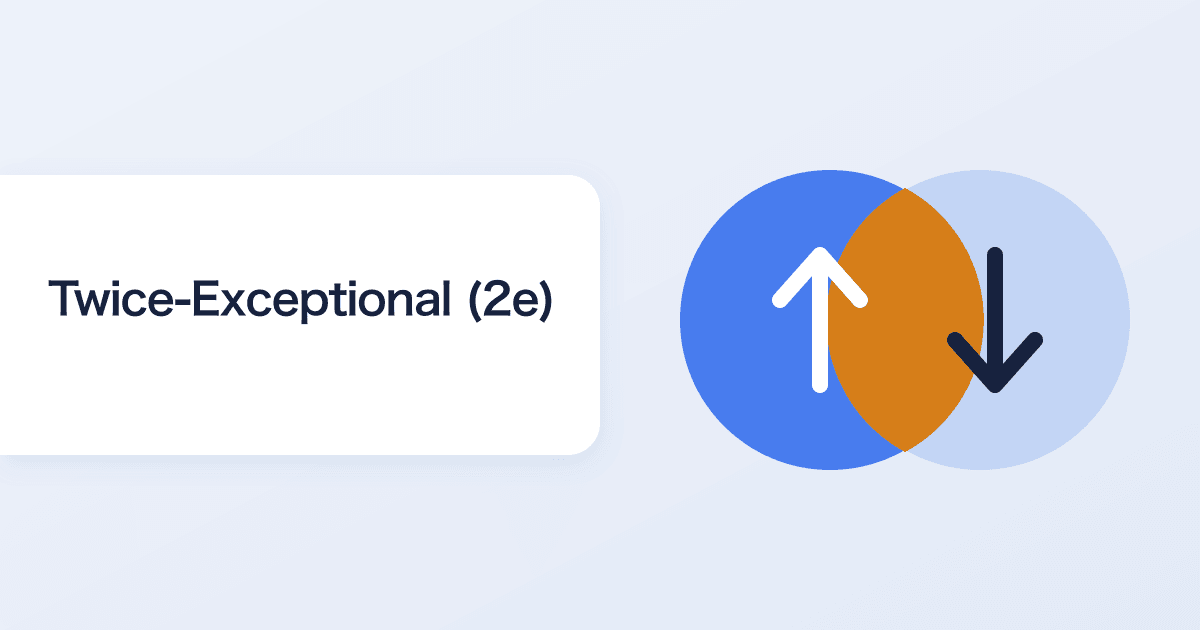
Twice-exceptional (2e) describes someone who simultaneously has high intellectual ability and a learning disability or developmental condition. Because the two sets of characteristics conceal each other, both are easily missed — a structural problem. This article works through the mechanism starting from how intelligence-test data should be read.
Why 'twice'
At the center of 2e is masking. High reasoning ability compensates for the difficulty, so performance settles near average and the person is never identified as needing support. At the same time, the difficulty prevents the high ability from being expressed, so they do not meet gifted-identification thresholds either.
The result is that they are treated as 'an average person, neither exceptionally strong nor in any particular difficulty.' In reality both characteristics are strongly present — but on a single composite score, the two cancel out.
Look at the scatter, not the composite
The key to detecting this structure is not composite IQ but the discrepancy between subtests. Formal instruments like the WAIS and WISC produce separate index scores for verbal comprehension, perceptual reasoning, working memory, and processing speed.
In a 2e profile, perceptual reasoning may be very high while processing speed falls well below average, producing a large spread between indices. The composite averages out to an unremarkable value, but the shape of the profile is anything but unremarkable.
Index structure is covered in what is the WAIS, and testing in children in IQ testing for children.
Commonly co-occurring characteristics
Combinations discussed relatively often under the 2e heading include the following. Individual variation is large, and the list below is not a set of diagnostic criteria.
- Reading and writing difficulty (dyslexia): fast reasoning, but slow processing of written information
- Attention characteristics (ADHD): deep focus in areas of interest, difficulty sustaining it elsewhere (see ADHD and IQ)
- Autism spectrum conditions: deep knowledge in specific areas, difficulty reading implicit context (see autism and IQ)
- Developmental coordination disorder: manual work that cannot keep up with the speed of thought
Where processing speed is involved, timed tests are especially prone to underestimating ability (see what is processing speed (Gs)).
The secondary problems that missing it creates
In practice the bigger issue with 2e is not the score but the mismatch in how others perceive it. When 'understands quickly but cannot hand work in' is interpreted as a matter of effort rather than ability, the person's self-assessment drifts a long way from their actual capability.
On self-assessment, a pattern opposite to the Dunning–Kruger effect is common: treating a strong domain as 'something anyone can do' while generalizing a weak domain into an overall deficiency (see the Dunning–Kruger effect).
Proper assessment requires a formal test
Assessing 2e is not something a quick online test can do. Interpreting index scatter clinically requires a formal instrument administered under a standardized procedure by a qualified examiner, together with information about learning and behavior. This article is a general explanation, not a diagnosis or medical advice.
That gifted identification itself has no single criterion is covered in what does gifted mean.
Start by seeing the shape of your unevenness
It is no substitute for a formal assessment, but it is a starting point for a rough sense of where your reasoning is skewed. BrainRank's free IQ test scores 20 questions across spatial reasoning, pattern recognition, logical reasoning, and classification (about 10 minutes) domain by domain, so alongside the composite estimate you can see where the gaps fall. Results are reported on the mean-100, SD-15 scale and line up directly with our IQ distribution data.
Share this article
Related articles
- ADHD and IQ: Is Average IQ Lower? WISC Profiles and High-IQ ADHD
- Autism and IQ: Intellectual Disability Rates and Test Profiles
- Does Reading Raise IQ? What Twin Studies and Meta-Analyses Show
- Fluid vs Crystallized Intelligence: How the Two Differ by Age
- The Dunning–Kruger Effect: Why Self-Assessment Misses, Seen Through IQ
- What Is the g Factor? A Plain-Language Guide to General Intelligence and CHC Theory
Editorial note & disclaimer
BrainRank Editorial Team
This article was written and edited by the BrainRank Editorial Team with reference to academic literature on psychometrics, including CHC theory and Item Response Theory (IRT). Statistics and percentages are calculated from a normal distribution model with a mean of 100 and a standard deviation of 15.
The tests on this site provide estimates for entertainment and self-understanding purposes only. They are not medical or clinical assessments, nor official psychological (intelligence) tests.