
Is an IQ of 90 Low? How to Read a Score Inside the Average Range
/
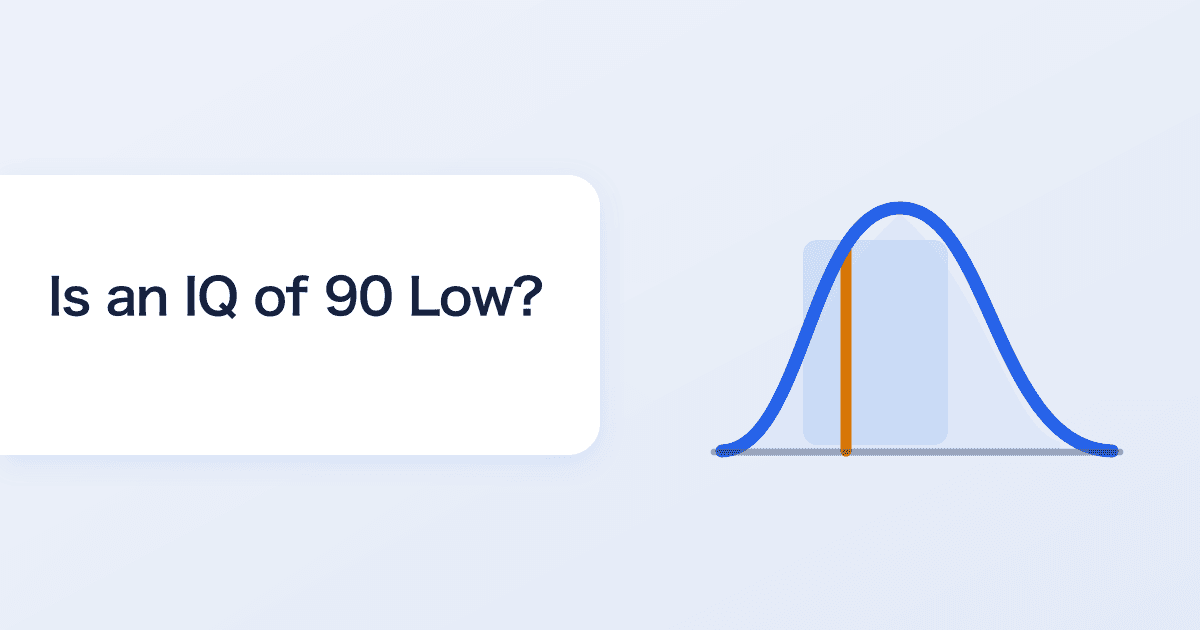
In brief: An IQ of 90 is not a score you can call low: it sits inside the average range (IQ 85 to 115). On the mean-100, SD-15 model it equals a deviation score of 43.3, roughly the top 75% (the bottom 25%).
An IQ of 90 is not low — statistically it falls inside the average range. On a normal distribution with a mean of 100 and a standard deviation of 15, it sits −0.67 standard deviations from the mean, converting to a deviation score of 43.3, with about 25% of people scoring below it. This article works through what that figure actually means.
The core numbers for IQ 90 (mean 100, SD 15)
Running IQ 90 through the SD-15 normal distribution model gives:
- Standard score (z): −0.67
- At or below this IQ: about 25.3%
- Deviation score: 43.3
- Band: lower half of the average range (IQ 85–115)
What matters is that IQ 90 sits inside the average band. By convention in psychological testing, the mean ±1 SD — IQ 85 to 115 — is the average range, and about 68% of people fall in it. An IQ of 90 is comfortably within that. Every score's position is laid out in our IQ reference table, and the population share of each band in our IQ distribution data.
Converting to a deviation score changes the impression
IQ 90 feels low mainly because 100 reads like a near-perfect mark. But IQ is a position, not a point total, so translating it into the deviation score familiar from school exams tracks intuition better.
Deviation score = 50 + (IQ − 100) ÷ 15 × 10. By that formula, IQ 90 is a deviation score of 43.3. A 43 on a practice exam reads as 'slightly below average but well within reach,' and IQ 90 occupies exactly the same position. The full conversion procedure is in converting between IQ and deviation scores.
Look at the uneven profile, not the composite
Around IQ 90, the profile of strengths and weaknesses across domains matters far more in daily life than a few points of composite score. Two people with the same composite — one strong in spatial reasoning and weak in verbal processing, the other the reverse — suit different tasks and learn in different ways.
This maps onto the distinction in fluid and crystallized intelligence. Crystallized intelligence (Gc) — knowledge, vocabulary, experience — keeps growing with age, so an early composite score does not have to settle anything (see IQ and age).
Do not treat one result as a fixed value
Even a standard intelligence test carries a standard error of measurement of around ±5 points, and condition, sleep, and familiarity with the format move the number by several points on their own. IQ 90 and IQ 95 are statistically hard to distinguish. That goes double for quick online tests, where reading the trend across multiple sittings and formats is the sensible approach (see how accurate are free IQ tests). One step lower, the IQ 70–84 band is sometimes called "borderline intellectual functioning"; its definition, share of the population, and boundary with the average range are covered in what is borderline intellectual functioning?.
Focus on what actually moves
Honestly, the evidence for substantially raising composite IQ is thin (see can you raise your IQ?). What does affect real performance is familiarity with question formats, how you deploy working memory, and the foundations of sleep and aerobic exercise. Approaches to figure problems are in how to solve matrix reasoning problems, and memory technique in how to train working memory.
Start by learning your own profile
Before asking whether a number is low, find out which domains are strong and which are weak. BrainRank's free IQ test scores 20 questions across spatial reasoning, pattern recognition, logical reasoning, and classification (about 10 minutes) domain by domain, reporting an estimated IQ, deviation score, and percentile on the same mean-100, SD-15 scale used here. No signup, and the shape of your profile is shown directly.
Frequently asked questions
- Is an IQ of 90 low?
- By the usual classification, an IQ of 90 falls inside the average range (IQ 85 to 115). It is slightly below the mean but within the average band.
- What percentile is an IQ of 90?
- On a normal distribution with a mean of 100 and an SD of 15, roughly the top 75%, or the bottom 25%.
- What deviation score is an IQ of 90?
- Converted to a deviation score with a mean of 50 and an SD of 10, about 43.3.
Share this article
Related articles
- What Is Borderline Intellectual Functioning? IQ 70–84 and 1 in 7
- What IQ Is the Top 1%? Top 2%, 10%, and 0.1% Cutoffs at a Glance
- What Percentage Has an IQ of 160? The Top 0.003%, About 1 in 31,560
- What Is the Average IQ? The Basics of Standard Deviation and Distribution
- What Is IQ? Meaning, Origin, and the Basics of the Intelligence Quotient
- Intellectual Disability and IQ: Mild, Moderate, Severe Ranges
Editorial note & disclaimer
BrainRank Editorial Team
This article was written and edited by the BrainRank Editorial Team with reference to academic literature on psychometrics, including CHC theory and Item Response Theory (IRT). Statistics and percentages are calculated from a normal distribution model with a mean of 100 and a standard deviation of 15.
The tests on this site provide estimates for entertainment and self-understanding purposes only. They are not medical or clinical assessments, nor official psychological (intelligence) tests.