
What Is Brain Rot? The Word, the Origin, and What It Does to You
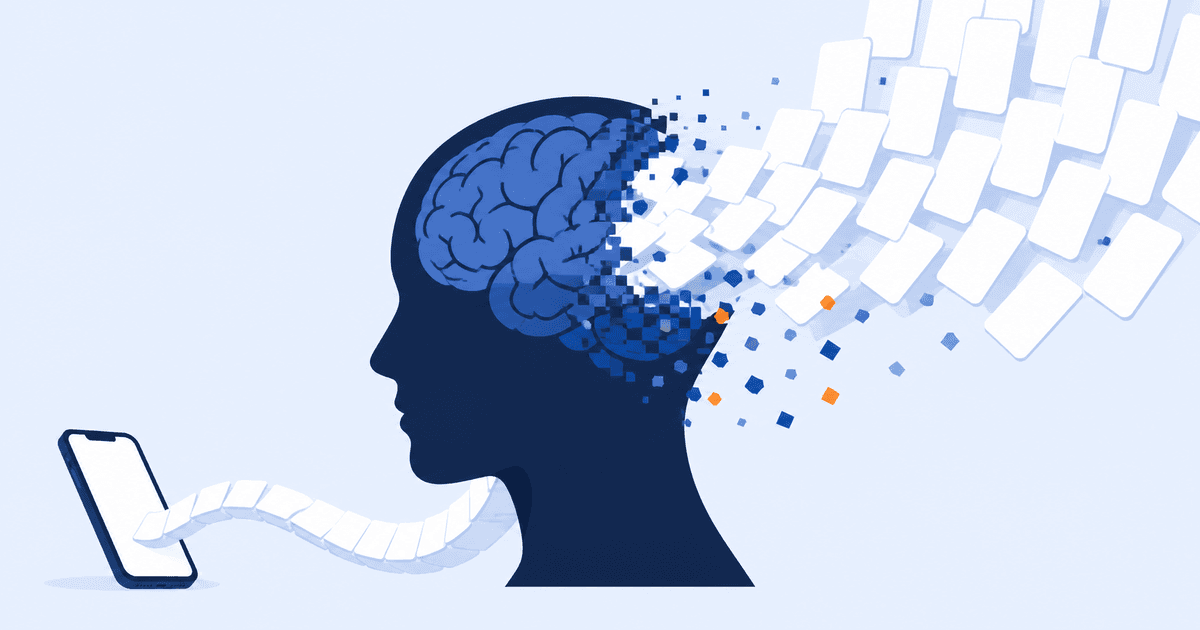
In brief: Brain rot is a colloquial term for the supposed deterioration of a person's mental or intellectual state following heavy consumption of trivial online content. Oxford University Press named it Word of the Year for 2024. It is not a medical diagnosis, and no study has shown that watching such content permanently lowers intelligence.
Brain rot refers to the supposed deterioration of a person's mental or intellectual state that follows heavy consumption of trivial online content. Oxford University Press named it Word of the Year for 2024, and the term spread quickly. It is not a medical diagnosis, however, and no study has demonstrated that watching this content makes you less intelligent. This article separates what the word means from what is actually happening.
What is brain rot? Oxford's Word of the Year 2024
In December 2024, following a public vote with more than 37,000 participants, Oxford University Press selected brain rot. Their definition is 'the supposed deterioration of a person's mental or intellectual state, especially viewed as the result of overconsumption of material (now particularly online content) considered to be trivial or unchallenging.' By their count, usage of the term rose 230% between 2023 and 2024.
The most important word in that definition is 'supposed.' The people who chose the term built the absence of an established causal link into the definition itself. Brain rot is best understood not as a demonstrated condition but as a name attached to a feeling many people recognize.
The origin is Thoreau's Walden, 1854
It looks like a recent piece of internet slang, but the first recorded use is generally traced to Henry David Thoreau's Walden (1854). He was criticizing a society that dismissed complex thought in favor of simple ideas, comparing it to a potato blight of the day. That a 170-year-old phrase won in 2024 is itself a reminder that the worry about new media eroding thought recurs in every era. The same pattern appears in the history of the IQ test.
Why it feels like your head will not turn over
The easiest explanation for the feeling is not a drop in ability but a change in how attention is spent. Watching short videos one after another means switching context every few tens of seconds. Each switch requires clearing the remains of the previous task and reloading the cues for the new one, so the same amount of work takes longer overall.
The load lands directly on working memory. There is a limit to how much can be held at once, so the more switching there is, the less capacity remains for holding the thing you are currently thinking about. Long text failing to go in is better described as having spent that holding capacity already than as a decline in reading ability.
Usage time is also rising. In the FY2024 survey from Japan's Institute for Information and Communications Policy, average internet use across all age groups was 181.8 minutes on weekdays and 183.7 minutes on weekends, both up from the previous year.
What the research shows and does not show
There is no standardized instrument that measures a condition called brain rot. That means no figure like 'X% of people have brain rot' can be produced. Here is the current boundary:
- Supported: frequent switching lowers efficiency while it is happening
- Supported: sleep loss and heavy fatigue lower same-day performance on cognitive tasks
- Not supported: watching short-form video permanently lowers intelligence
- Not supported: intelligence can be inferred from viewing time
Confusing correlation with causation is the most common error in this topic. Even if heavy viewers score lower, other factors such as sleep and daily rhythm may drive both. Findings on digital devices and cognition actually point the other way in places, which we cover in digital dementia and the smartphone brain.
Cut the number of switches, not the viewing time
If you want the feeling to ease, reducing switches is more realistic than reducing viewing to zero.
- Batch similar work: fix set times for checking messages, such as three times a day
- Turn off notifications: an interruption is a switch you did not choose
- Decide the end before you start: bound it by count ('one more'), not by clock time
- Protect sleep first: it has the largest effect on same-day performance
- Read one long piece a day: practice holding without switching
None of this is about training your way to a higher IQ. It is about removing what keeps your current ability from showing up, a distinction we keep in can IQ be raised. The same idea pushed toward abstinence is the dopamine detox, where the explanation is far more confused than the practice.
Check the feeling against a number
The sense that your thinking is duller than it used to be can diverge from actual performance. On gaps between self-assessment and ability, see the Dunning-Kruger effect. BrainRank's free IQ test scores 20 questions across spatial reasoning, pattern recognition, logical reasoning, and classification (about 10 minutes) using item response theory (IRT), returning an estimated IQ on the mean-100, SD-15 scale along with domain-level tendencies. Results are estimates for entertainment and self-understanding, not a medical or diagnostic assessment.
Frequently asked questions
- Is brain rot an illness or a diagnosis?
- No. It is a colloquial term for a state, not a medical diagnosis. There is no standardized test and no diagnostic criteria, so there is no way to measure whether someone 'has' brain rot.
- Does watching short-form video actually make you less intelligent?
- There is no decisive evidence that viewing permanently lowers intelligence. Frequent switching does reduce efficiency while it is happening, but that is a temporary state and is distinct from a change in ability itself.
- What should I do if I feel like I have brain rot?
- Cutting the number of switches is more practical than cutting viewing time to zero. Turning off notifications, batching similar tasks, and protecting sleep first are the three that tend to work.
Share this article
Related articles
- ADHD and IQ: Is Average IQ Lower? WISC Profiles and High-IQ ADHD
- Autism and IQ: Intellectual Disability Rates and Test Profiles
- Does Reading Raise IQ? What Twin Studies and Meta-Analyses Show
- IQ and Academic Performance: What a Correlation of 0.5 Actually Means
- Does Caffeine Make You Smarter? Effects on Focus and Memory, and Their Limits
- Multiple Intelligences Theory: The Eight Intelligences and How It Conflicts with IQ
Editorial note & disclaimer
BrainRank Editorial Team
This article was written and edited by the BrainRank Editorial Team with reference to academic literature on psychometrics, including CHC theory and Item Response Theory (IRT). Statistics and percentages are calculated from a normal distribution model with a mean of 100 and a standard deviation of 15.
The tests on this site provide estimates for entertainment and self-understanding purposes only. They are not medical or clinical assessments, nor official psychological (intelligence) tests.