
Raven's Progressive Matrices: The Standard Non-Verbal IQ Test Explained
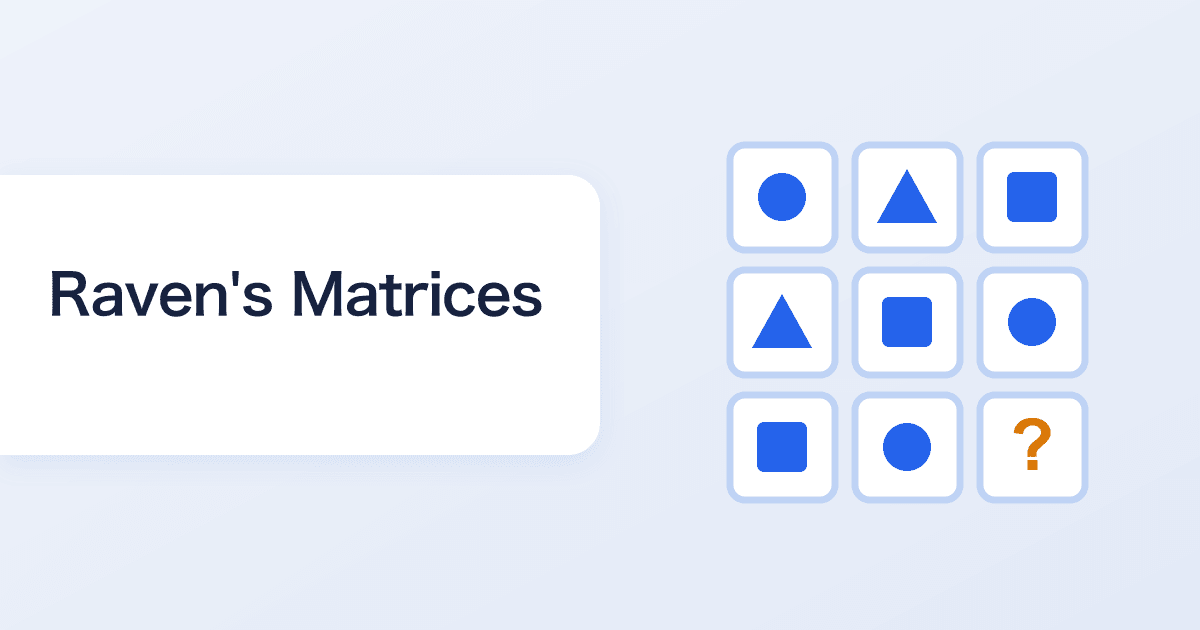
Raven's Progressive Matrices (RPM) has been the most widely used format for measuring reasoning ability with almost no language since its publication in 1938. Nearly every '3×3 grid with a missing cell' problem you see on an online IQ test descends from this test.
What the test looks like
Test takers see a 3×3 (or 2×2) grid of abstract figures with the bottom-right cell blank. Spot the rule running through the grid and choose the figure that belongs in the blank — that is the only task format there is.
Beyond the instructions it requires no language and presupposes no academic knowledge, so it can be administered in identical form to groups differing in native language and education. That property is why it has been used for international comparison and for assessing test takers with language impairments.
What 'progressive' means
The 'progressive' in the name refers to a design in which difficulty rises in stages as you advance. What drives difficulty is not the visual complexity of the figures but the number of rules operating simultaneously within a single item.
Carpenter, Just & Shell's (1990) analysis showed that RPM difficulty is largely explained by that number of concurrent rules and the working-memory load of holding them. Early items run on one rule; later items stack two or three.
In practice the standard approach is to check in a fixed order: rows, then columns, then the relationship between them. The procedure is broken into three steps in how to solve matrix reasoning problems.
Why it is treated as an indicator of g
RPM is known for correlating unusually highly with g among cognitive tasks, and it is often treated as a representative indicator of it. The reason is that the format demands almost no accumulated knowledge and isolates the ability to construct a rule on the spot — what CHC theory calls fluid reasoning (Gf) (see g factor and CHC theory).
The flip side is equally clear: what RPM does not measure. Vocabulary and general knowledge (crystallized intelligence, Gc), processing speed, and interpersonal ability cannot be assessed in this format (see fluid and crystallized intelligence). Reading an RPM result alone as 'overall intelligence' is a mistake.
The limits of 'culture fair'
RPM was long described as culture-free or culture-fair, but that description is now treated with care. Even without language, experience handling abstract figures, familiarity with the task framing of hunting for rules on a page, and general test-format fluency all vary with educational environment.
In fact RPM mean scores rose throughout the 20th century in country after country. Biological intelligence changing that much in a few decades is implausible, so the shift is interpreted as largely environmental — increasing familiarity with abstract thought among other factors (see the Flynn effect). The same reasoning is why comparisons of national average IQ warrant caution (see how reliable is average IQ by country).
Official RPM versus online tests
The official RPM is a copyrighted psychological instrument, administered under a standardized procedure by qualified examiners. The free 'matrix problems' published on the web are not RPM itself but original items imitating the format.
That distinction bears directly on how to read a result. An official test is normed on a representative sample, so comparison against others is possible; with imitation items, the quality of the norming determines what the result means. This is covered in detail in how accurate are free IQ tests and what is the WAIS.
Try the same format yourself
BrainRank's free IQ test includes matrix and series problems in the same family as RPM across 4 domains and 20 questions (about 10 minutes), scored with item response theory (IRT). Because each item's difficulty and discrimination are built into the model, the estimated IQ comes from your response pattern rather than a raw count. To get familiar with the format, see our pattern recognition guides.
Share this article
Related articles
- Intellectual Disability and IQ: Mild, Moderate, Severe Ranges
- What Is the Average IQ in Japan? The 106 Claim, Examined
- ADHD and IQ: Is Average IQ Lower? WISC Profiles and High-IQ ADHD
- Does Relying on AI Weaken Thinking? The Science of Cognitive Offloading
- How to Solve Number Sequences: 4 Steps for Spotting the Rule
- How to Train Spatial Reasoning: Boosting Mental Rotation in Daily Life
Editorial note & disclaimer
BrainRank Editorial Team
This article was written and edited by the BrainRank Editorial Team with reference to academic literature on psychometrics, including CHC theory and Item Response Theory (IRT). Statistics and percentages are calculated from a normal distribution model with a mean of 100 and a standard deviation of 15.
The tests on this site provide estimates for entertainment and self-understanding purposes only. They are not medical or clinical assessments, nor official psychological (intelligence) tests.