
Does Music Make You Smarter? The Mozart Effect and Music Lessons, Tested
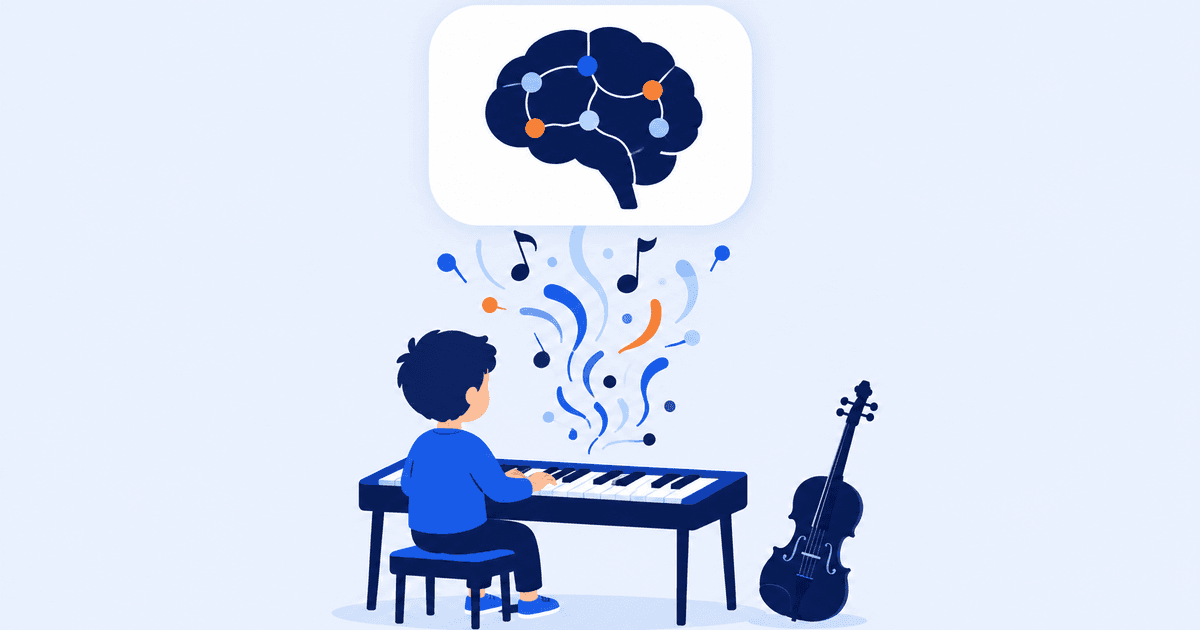
In brief: The claim that music raises intelligence, whether by listening or by lessons, is not supported by current evidence. The "Mozart effect" reported by Rauscher and colleagues (1993, Nature) was a gain in spatial reasoning lasting only 10 to 15 minutes; a meta-analysis by Pietschnig and colleagues (2010) found the effect small and equally present for any enjoyable music or story, so it is interpreted as an arousal and mood effect. For music lessons, Schellenberg (2004) reported a 2.7-point IQ difference in an experiment with 144 six-year-olds, but Sala and Gobet (2020), pooling 54 studies and 6,984 children, found an overall effect of g ≈ 0.06 and no effect in well-designed studies.
"Play Mozart to your unborn baby." "Piano lessons make kids smarter." Claims linking music to intelligence are persistent and recur in ads for educational products and lessons. This article lines up the two famous studies that started it all against the meta-analyses that tested them, and sorts what survived from what did not.
Where the Mozart effect began
It started with a one-page report by Rauscher, Shaw, and Ky (1993, Nature). Thirty-six college students spent 10 minutes under one of three conditions, listening to Mozart's Sonata for Two Pianos (K. 448), listening to a relaxation recording, or sitting in silence, then took spatial reasoning tasks. Scores after Mozart were higher than in the other conditions, a difference equivalent to 8 to 9 IQ points.
But as the paper itself states, the effect lasted only 10 to 15 minutes. And what was measured was a spatial reasoning subtest, not intelligence in general. Even so, the finding spread in the simplified form "Mozart makes you smarter," to the point that in 1998 the state of Georgia announced a plan to give every newborn a classical music CD.
What survived meta-analysis
Dozens of replications followed. Pietschnig, Voracek, and Formann (2010, Intelligence) pooled about 40 studies and roughly 3,000 participants. Three points sum up the result.
- The difference between Mozart and silence was small, and larger in studies from Rauscher's own lab than elsewhere
- Comparing Mozart with other music, there was almost no difference
- There were signs of publication bias
The decisive point was "other music works just as well." Thompson, Schellenberg, and Husain (2001, Psychological Science) showed that a fast, bright Mozart piece improved spatial task scores while a slow, somber Albinoni piece did not, and that the difference was explained by arousal and mood. In short, any stimulus you enjoy lifts your mood and slightly improves the task right after; it is a general phenomenon, not something specific to Mozart.
What if you learn rather than listen?
Even with the listening effect gone, the question remains whether lessons are different. Schellenberg (2004, Psychological Science) addressed it head on. He randomly assigned 144 six-year-olds to four groups, 36 weeks of keyboard lessons, voice lessons, or drama lessons, or no lessons, and measured IQ before and after.
The two music groups gained an average of 7.0 IQ points; the drama and no-lesson groups gained 4.3 (all groups gain because of a year's growth and practice effects). The 2.7-point difference was statistically significant, but the author himself called it relatively small. The drama group improved in social skills; the music groups did not.
This was a high-quality design with random assignment and an active control (drama). The question was whether the result would replicate.
A meta-analysis of 54 studies
Sala and Gobet (2020, Memory & Cognition) pooled 54 studies of music training in children with 6,984 participants. The outcomes were cognitive abilities (intelligence, memory, spatial ability, and so on) and academic achievement.
The overall effect was g ≈ 0.06, effectively zero. Restricting to well-designed studies meeting both conditions, random assignment and an active control group, no effect was detected. Studies reporting effects tended to use a do-nothing control or non-random assignment.
This is the general rule of training research. Practicing an instrument reliably improves playing skill and nearby abilities such as pitch and rhythm discrimination (near transfer). Transfer to intelligence in general (far transfer) is limited. The same pattern appears in brain-training hobbies, bilingualism and executive function, and Can you raise your IQ?.
Why the correlation appears
Still, many surveys find that children who play music have higher IQs. If interventions show no effect but the correlation persists, the explanation lies in selection.
Children who stick with an instrument tend to come from families with higher income and parental education, to have the self-control to keep practicing, and to be higher in openness to new experience. Each of these also correlates with IQ. So rather than "music raised their IQ," most of the correlation is explained the other way: children with the conditions for higher IQ are more likely to keep up music. It is the same structure discussed in IQ, genes, and environment.
Reasons to learn music anyway
To sum up, playing music to a child or enrolling them in lessons "to raise IQ" rests on weak grounds. On the other hand, being able to play an instrument, listening to music with understanding, performing in front of people at a recital, and the habit of steady practice are valuable regardless of the intelligence debate. There is no need to look for the payoff in IQ.
If wanting to know a child's abilities is the motivation behind this, the article on IQ tests for children covers the limits of measurement by age and when each kind of test fits.
Measure where your spatial reasoning stands now
What the Mozart-effect studies measured was spatial reasoning. You can check how your own spatial reasoning compares with your other domains through domain scores. BrainRank's free IQ test scores 20 questions (about 10 minutes) across spatial reasoning, pattern recognition, logical reasoning, and classification using item response theory (IRT), and returns your profile by domain. How the domains relate is summarized in our skill correlation data. Results are estimates for entertainment and self-understanding, not a medical or diagnostic assessment.
Frequently asked questions
- Is the Mozart effect real?
- In a narrow sense yes, in the popular sense no. The original study found that spatial reasoning improved for 10 to 15 minutes right after listening to a Mozart sonata for 10 minutes. Meta-analysis shows the effect is small and occurs just as much with music you like or a story read aloud, so it is understood as an arousal and mood effect, not anything specific to Mozart.
- Do piano lessons raise a child's IQ?
- A 2020 meta-analysis of 54 studies and about 7,000 children found the effect of music training on cognitive ability and school achievement to be near zero (g ≈ 0.06), and no effect in studies with random assignment and an active control group. The correlation between music lessons and higher IQ is explained by family background and pre-existing ability.
- Is there still a point in learning music?
- Yes. Instrumental skill, musical understanding, and auditory discrimination clearly improve, and enjoyment and accomplishment are valuable in themselves. The only weak reason is "to raise IQ," which is this article's conclusion.
Share this article
Related articles
- ADHD and IQ: Is Average IQ Lower? WISC Profiles and High-IQ ADHD
- Autism and IQ: Intellectual Disability Rates and Test Profiles
- Does Reading Raise IQ? What Twin Studies and Meta-Analyses Show
- What Is the Flynn Effect? Why Global IQ Rose — and Recently Stalled
- Does Sleep Loss Lower Your IQ? What the Research Actually Shows
- What Is Processing Speed (Gs)? How to Improve Cognitive Speed, and Its Limits
Editorial note & disclaimer
BrainRank Editorial Team
This article was written and edited by the BrainRank Editorial Team with reference to academic literature on psychometrics, including CHC theory and Item Response Theory (IRT). Statistics and percentages are calculated from a normal distribution model with a mean of 100 and a standard deviation of 15.
The tests on this site provide estimates for entertainment and self-understanding purposes only. They are not medical or clinical assessments, nor official psychological (intelligence) tests.