
Is Multitasking Really Inefficient? The Real Cost of Switching
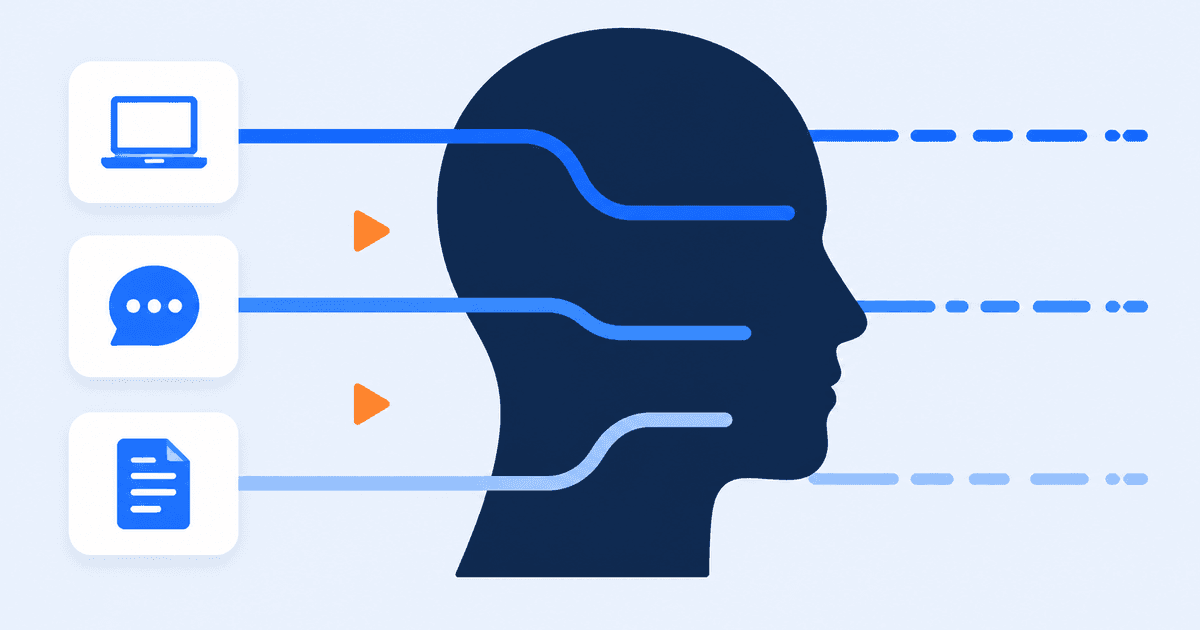
In brief: The brain does not run two cognitive tasks at once; it switches between them quickly. In the experiments of Rubinstein, Meyer, and Evans (2001), the time lost at each switch grew as tasks became more complex and less familiar. The often-quoted 'up to 40% less productive' is not a measured value from that paper — it is an estimate the author offered as an implication. The fix is not willpower but design.
Multitasking is inefficient not because your willpower is weak, but because the brain is not running two cognitive tasks in parallel — it is switching fast between them. Every switch takes time, and the sum of that time is why a day of constant activity produces so little progress. This article covers the size of the cost, where the famous number comes from, the exceptions, and what actually helps.
It is switching, not parallel processing
Two tasks feel simultaneous because the switch is quick. When you switch between cognitive tasks, the brain performs at least two operations: goal shifting (setting what you are doing now) and rule activation (making that task's procedures usable).
Neither is instant. That is why returning to task A never feels smooth at first — the previous task's rules are still active and interfering.
What the experiments measured
The reference point is Rubinstein, Meyer, and Evans (2001, Journal of Experimental Psychology: Human Perception and Performance). Young adults ran four experiments alternating between different tasks, such as solving arithmetic problems and classifying geometric objects.
The result was clear. Every switch cost time, and the loss grew larger as the tasks got more complex and larger again when the task being switched to was relatively unfamiliar. The cost is not a fixed toll; it scales with the difficulty of what you are handling.
The frequently quoted 'productivity can drop by as much as 40%' is not a value that paper measured. It appears in APA's feature on the research, where Meyer offered it as an implication of the mental blocks created by switching. For practical purposes, the relationship — harder work loses more per switch — is more useful than the number.
What about people used to multitasking?
Do people who habitually run several media streams at once get better at switching? Ophir, Nass, and Wagner (2009, PNAS) reported that heavy media multitaskers were more susceptible to interference from irrelevant environmental stimuli and from irrelevant representations in memory.
That result has not held up consistently in replications. Some studies found the opposite direction, and meta-analyses pooling the literature put the association between media multitasking and cognitive control at small. Neither 'practice makes you stronger' nor 'practice makes you weaker' is a claim the evidence currently supports.
What can be said with confidence is the previous section: switching itself has a cost.
Which combinations are cheap, and which are expensive
Not all parallel work is equally wasteful. The dividing line is whether one side is automated.
- Low cost: talking while walking, listening to music during routine work (one side runs automatically)
- High cost: writing while answering chat, drafting email during a meeting (both need language and judgment)
Stacking tasks that compete for the same resource produces interference. Writing and replying to chat is the worst pairing there is, because both draw on language processing and working memory.
The fix is design, not willpower
To switch less, remove the situations that invite switching.
1. Batch: group similar work into one block. Give email a fixed time slot
2. Kill notifications: interruptions arrive from outside your intentions. Turning them off is the highest-yield change
3. One screen, one task: keep other work out of sight. Close the tabs
4. Leave a note when you break off: it lowers the restart cost when you come back
5. Reserve longer blocks for harder work: the cost scales with difficulty
Points 1 and 5 share a principle. Cut the number of switches and the total loss falls even if each individual switch is expensive. On the role of notifications, see is the eight-second attention span real; on what chronic switching does to memory, see digital dementia and brain rot.
Is multitasking ability a separate talent?
It is hard to isolate 'good at multitasking' as an independent trait. Switching speed and resistance to interference are largely explained by executive function and working memory capacity. Rather than a distinct gift, it is better read as one expression of abilities we already measure.
Domain scores give you a hint about where your own bottleneck sits. BrainRank's free IQ test scores 20 questions across spatial reasoning, pattern recognition, logical reasoning, and classification (about 10 minutes) using item response theory (IRT) and returns per-domain tendencies. Results are estimates for entertainment and self-understanding, not a medical or diagnostic assessment.
Frequently asked questions
- Can humans really not process things in parallel?
- You can pair an automated action (walking, humming) with a task that needs attention. But two tasks that both demand judgment or language do not run at the same time — they alternate, and each alternation costs time to swap goals and reactivate rules.
- Is it true that multitasking cuts productivity by 40%?
- That figure was not measured in the paper. It appears in an APA feature about the 2001 switching-cost experiments, where the author Meyer offered it as an implication. What the experiments showed is a relationship: the more complex and unfamiliar the task, the larger the switching loss.
- Are some people good at multitasking?
- People who rate themselves as good at it do not perform better. Studies of heavy media multitaskers exist, but the early findings have not replicated consistently, and meta-analyses put the effect size at small.
Share this article
Related articles
- ADHD and IQ: Is Average IQ Lower? WISC Profiles and High-IQ ADHD
- Autism and IQ: Intellectual Disability Rates and Test Profiles
- Does Reading Raise IQ? What Twin Studies and Meta-Analyses Show
- Is Average IQ by Country Reliable? The Limits Explained
- Intellectual Disability and IQ: Mild, Moderate, Severe Ranges
- Low Working Memory: Signs in Adults and Children, and What Helps
Editorial note & disclaimer
BrainRank Editorial Team
This article was written and edited by the BrainRank Editorial Team with reference to academic literature on psychometrics, including CHC theory and Item Response Theory (IRT). Statistics and percentages are calculated from a normal distribution model with a mean of 100 and a standard deviation of 15.
The tests on this site provide estimates for entertainment and self-understanding purposes only. They are not medical or clinical assessments, nor official psychological (intelligence) tests.